Jeffrey Schiff
Devices
Recent Work
Installations
Public Commissions
Sculpture
Performance & Interactivity
Drawings & Photoworks
Early Work
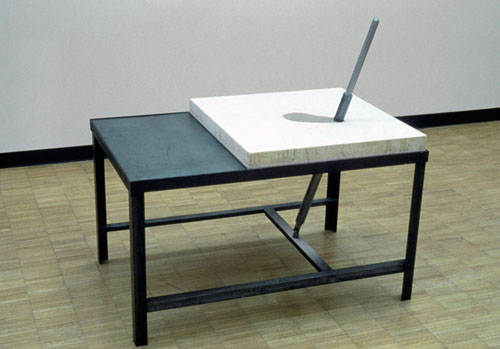
5 of 16, Opening Up Click for detail

 Return to Sculpture
Collection San Diego Museum of Contemporary Art
Year: 1987
Materials: steel, concrete, carbonendrum
Dimensions: 3.5' x 4' x 2.5'
A slab of concrete set into a steel table is penetrated by a long steel shaft. The shaft is surfaced with abrasive carburendum and pivots from a universal joint attached to the table frame. By rotating the shaft against the opening, the abrasive slowly grinds away the concrete slab.
DEVICES
Sculpture Center, New York, NY
October 12 - November 3, 1993
Jeffrey Schiff's devices center on the psychologically resonant physicality of the tool. Their formal elegance suggests careful design rather than ad-hoc ingenuity. This leads one to expect that these objects, as well-made tools, will be intelligible in terms of some underlying purpose. Instead of being stable images or representations, they act as catalysts for speculative scrutiny. As one attempts to work out their purpose, it becomes clear that these singular objects have a multiplicity of ways and meanings. They trigger an investigation which can never be satisfactorily concluded. The tools are themselves work sites — work sites for interpretation.
Device (universal set) is made up of several wooden handles each affixed to a different steel fitting. The grouping leans against the wall, resembling the motley completeness of an assortment of yard tools. But the handles are too long and the fittings do not correspond to any known task. The fittings are intriguing: three are arcs of different curvature, two are flat plates, three more are rectilinear. They constitute an oddly tasteful exploration of a range of formal possibilities. But the exploration is not exhaustive nor are the forms canonical. For the set to be universal, the tools must be capable of an entire range of tasks, but the nature of that work—who, where, what, and why—can only be imagined.
While the tools as objects imply free-floating relationships between person and place unknown, Schiff's installations fix the place with the figure of a network, or field of vectors. These networks establish physical connections between particular tools or mechanisms and other elements, establishing concrete relations. They may suggest a flow of energy, the causal connection between elements, or the consequences of an action taken. They physically embody some sort of manipulation of the world by a presumably human agency.
Field of Play is quite explicit in this regard. An archaic plow sits with its wooden handle toward the entrance, situating every visitor "behind the plow." Attached to the steel blades of the plow are a collection of articulated metal rods, partially hidden. The plow has forced the rods to erupt from the earth, the unforeseen consequence of a single push forward. One is placed as the site of this simple action which has created a complex web of resistance, and one is invited to repeat it.
The overall body of Schiff's work forms a secondary network through the repetition and transformation of certain elements from device to device. These transformations establish and distinguish the crucial properties of each element, aiding the process of interpretation. For example, Device (outcast) consists of a wooden handle connecting small steel rings to a scattered series of cables. Attached to the cables are larger metal rings which are free to slide along the cable. The wooden handle and steel rings both recall Field of Play quite specifically. But here the rings slide along their cables to an end with a stop; they have become spots that pull rather than resist. It is as if they are collars for a collection of animals. A second piece, Device (ornamental whip) continues in this fashion: the cables are now rigidly attached to the end of the handle, suggesting a whip. The rings are replaced with iron decorations that, in this context, attain a rather sinister banality.
Throughout these pieces most of the materials are "permanent": steel, stone, lead, hardwood, etc. Reference to the human figure is conspicuously absent. Occasionally, however, contrasting materials appear that possess a softness or fleshiness that is delicate and temporary. In Device (advance notice), the linked rods are attached to trays containing sponges. The trays isolate or protect the sponges from the floor, suggesting the sponges' fragility, while the rods pierce through them, violating their delicacy. The nut at the end of each threaded rod is carefully adjusted to neither deform the sponge nor give it any free play. In the context of the other pieces, the brutality and precision of this arrangement suggests that the sponges are associated with the invisible owners of the collars and the potential victims of the wrought iron cat o' nine tails.
Another working of the network begins with the installation under(MINING). In that project, an adobe wall was built and then brought to the verge of collapse by a single pulley system. Separate cables radiate from the pulley to individual blocks of the wall. The pulley draws the cables in , bringing the wall to the brink of total disorder. "...or ever the silver cord be loosed, or the golden bowl be broken..." is almost the same situation, after collapse. Multiple pulleys have been assembled high on a wall, the bricks have become shattered fragments of limestone, and the cables are now lead wire that makes the light it catches appear dusty, as if the collapse were quite recent. Mass Candle inverts this relation. The spools are now disordered and passive. They are strewn on the floor, wound with strings spooled pout from a table of wax. Rising through the underside of the table, the strings become an ordered grid of candle wicks. Lighting these candles and then allowing them to burn would eventually perforate the table and disconnect the strings. This gives the table a fleshly impermanence that has none of the chaotic grandeur of shattered limestone or the collapsed wall. Kill van Kull offers a similar expression of potential energy released by a grid of points. A phalanx of spears (war? pestilence?) clamped onto the columns of a deteriorating neo-classical temple are aimed across a canal at opposing rows of oil tanks and refineries.
Through the obsessive working and reworking of the figures of the tool or device, and the network, Jeffrey Schiff produces a body of work that is simply too psychological to be working out a serial principle. Instead, these works become a series of material essays or physical meditations on the nature(s) of human agency.
Ron Kuivila